


Challenges: To succeed in today’s market, your transmission lubricants must meet increasing demands for fuel economy and emissions reduction without sacrificing wear protection. Your customers also require durability, even fill-for-life capability in passenger vehicles, despite ever more challenging operating conditions. And the market is being shaped significantly by the needs of electric vehicles.
How we can help: Our advanced synthetic base stocks and world-class formulation expertise help transmission lubricant manufacturers meet the needs of today’s – and tomorrow’s – drivetrains. Transmission lubricant formulators rely on our synthetic base stocks to deliver higher performance and lower viscosity while providing exceptional oxidative stability, shear stability and low temperature performance, which enable longer drain intervals and energy efficiency.
Market trends

Fragmented passenger vehicle market
Today’s passenger vehicle transmission market is fragmented, with preferred styles differing by region and even by areas within regions. These differences likely will continue in the near future. The largest EV presence is in Asia Pacific, with China leading global growth. We have seen large growth in dual-clutch transmissions (DCT) in China, while Japan still favors CVT. As automatic transmissions continue to dominate in the U.S., DCT popularity is growing in Europe, along with EV and hybrid vehicles.

Consolidated heavy-duty market
Unlike the fragmented passenger vehicle transmission market, the heavy-duty sector remains mostly unified. As the chart below makes clear, Class 8 transmissions account for more than 50% of global market share. More than 90% of Class 8 transmissions are manual or automated manual. Electrification is not expected for Class 8 in the near future, but we might see some growth in lighter commercial vehicles.
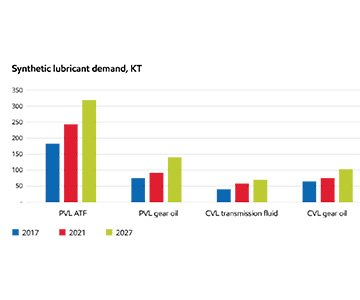
Synthetic lubricant growth
Despite the different styles, today’s drivetrains generally feature higher power outputs and more compact designs, with lower oil volumes in circulation. Higher temperatures are exceeded only by higher customer expectations for energy efficiency, wear protection and fluid durability. To meet these challenges, formulators are turning to synthetic base stocks, and forecasts see this trend continuing. The chart shows that while total lubricant growth will be limited, synthetics growth will be robust.
Lubricant solutions
Electric vehicle (EV) driveline fluids
Hybrid and electric vehicles bring new requirements for electrical and thermal properties in lubricants. Our scientists are creating breakthrough synthetic base stock formulations that meet the needs of this expanding market.
Applicable products:Automatic transmission fluids (ATFs)
To be competitive, ATF lubricants need enhanced durability, providing wear protection at lower viscosity as well as oxidative and shear stability even in extreme temperatures. That’s why more formulators are relying on our advanced synthetic base stocks for improved performance capabilities compared to mineral-based oils.
Applicable products:Continuously variable transmission fluids (CVTFs)
CVT fluids must provide balanced frictional properties for desirable performance in the chain- or belt-and-pulley system, bearings, clutch and torque converter. Customers also expect oxidative and shear stability, along with low-temperature performance. Our synthetic base stocks have demonstrated superiority to mineral-based oils in these and other performance areas.
Applicable products:Heavy-duty manual transmission fluids
Energy efficiency is becoming more critical than ever in the heavy-duty market. Through enhanced wear protection at lower viscosity, our advanced synthetic base stocks help finished lubricants meet evolving emissions regulations while increasing drain intervals even at high temperatures.
Applicable products:
Driveline fluids
Related products & solutions

SpectraSyn Plus™ PAO
SpectraSyn™ MaX PAO